
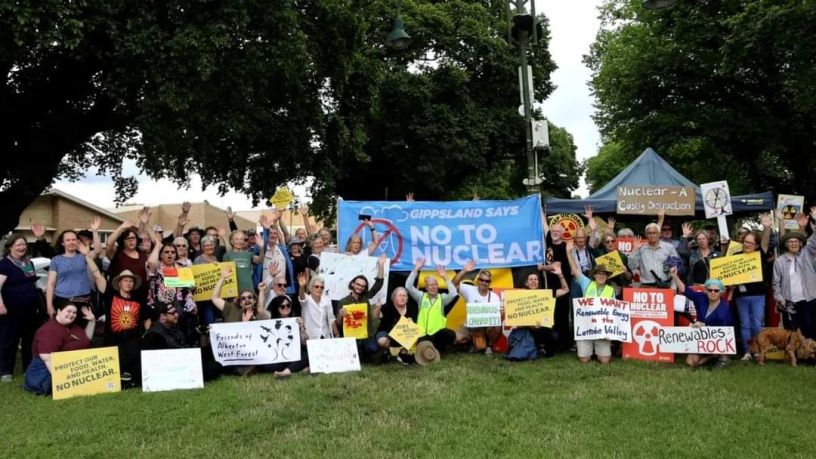

Speech by Dr. Margaret Beavis (OAM): a former general practitioner with a strong interest in public health. She now teaches at Melbourne University, serves as Vice-President of the Medical Association for Prevention of War and previously as Co-Chair of the International Campaign to Abolish Nuclear Weapons (ICAN) Australia.
Traralgon 3/12/24
Today I am going to talk about three aspects of nuclear power:
Health impacts, the risk of accidents and nuclear waste.
This is yet another industry claiming it is clean and safe, when it is clearly not.
Health Impacts of Radiation Exposure
We know radiation, such as that created by the nuclear power industry, causes damage to living cells. This applies particularly to DNA which is our genetic material.
We know there is background radiation in everyday life.
But the important fact here is that the more you are exposed the greater the health issues. These include greater risk of cancer. And for the last decade or so, we know there are also increases in cardiovascular diseases, like heart attacks and stroke
The more we learn about radiation effects, the greater those effects appear to be. Maximum permitted radiation dose limits for workers have never been raised; they have only ever been lowered. Since 1950 the maximum annual dose limits for workers declined from approximately 250 to the current limit of 20 millisievert (mSv) per annum.
Even this limit is not regarded as “safe”, but merely a compromise between, on the one hand, safety, and on the other hand commercial interests.
So much is said that radiation is harmless – but words are easy. I want you to think about a real world example. Why do you think every time you get an Xray- they have signs up asking if you are pregnant?
That is because we have known since the 1950s that X-raying an unborn child increases its risk of leukemia and other cancers.
Childhood leukaemia near nuclear power plants
Extra cases of leukaemia occurring in children living near nuclear power plants have caused concern and controversy over decades. In the 1980s excess cases of leukaemia and lymphoma were noticed around the Sellafield nuclear plant in England
A government investigation unexpectedly found that the risks for leukaemia and lymphoma were higher than in the surrounding population. In 2007, the US Department of Energy examined all of the reliable data available worldwide, confirming a significant increase in leukaemia for children living near nuclear power plants.
The clearest findings on this subject come from a large national German study, which examined leukaemia among children living near any of Germany’s 16 operating nuclear plants over a 25-year period.
It showed that the risk of leukaemia more than doubled for children living within 5 km of a nuclear plant, with elevated risk extending beyond 50 km from a plant.
Radiation also increases the risk of death from cancer and some non-cancer diseases, such as heart attack and stroke.
This has been clearly demonstrated not only at moderate and high doses, but also now we know that deaths are increased at low dosessuch as those that occur in nuclear industry workers.
False Health Claims
The Coalition has also made claims linking radiology, radiotherapy and nuclear medicine to Australia having nuclear power, claims which are false and deliberately misleading.
We have a world leading nuclear medicine sector, without having nuclear power reactors.
Nuclear Accidents
A lot has been said about the problem of nuclear accidents.
Again I want you to remember a real world example, when people tell you nuclear power plants are safe.
If they are so safe, why does every home insurance policy say they will not cover for damage from nuclear radiation?
If they are so safe, why is it always the tax payer who has to pay for the insurance of a nuclear power plant? No commercial insurance company would touch a nuclear reactor with a barge pole.
Complex technology systems all fail at some point, and nuclear power plants are no exception.
Nuclear reactors have the potential for radioactive releases that are enormous in size and last for years.
Although the best known such accidents are Windscale, Chernobyl, Three Mile Island and Fukushima, there have been at least fifteen accidents involving fuel or reactor core damage, with substantial risk of uncontrolled radioactive release, in a variety of reactor types in Canada, Germany, Japan, Slovakia, the United Kingdom, Ukraine and the United States.
In addition there have been many near-misses.
The most recent, the reactor melt downs at Fukushima, happened after a major earthquake and tsunami. More than ten years later, the power plants and spent fuel ponds are still leaking and dangerous, and vast amounts of contaminated water are being dumped into the Pacific Ocean.
The former Japanese prime minister, Naoto Kan, said there had been a real possibility of requiring the evacuation of 35 million Tokyo residents, were the fallout to threaten the capital.
It was dumb luck that Tokyo residents was not evacuated, because the prevailing winds in the first week of the disaster were largely offshore, dumping most of the fallout in the sea
The investigation into the Fukushima reactor disaster by the Japanese Diet (parliament) shows a multitude of errors and wilful negligence that left the Fukushima plant unprepared for the events of March 11.
Nuclear power plants are vulnerable to extreme weather: storms, floods droughts and fires.
We should be very sceptical of the nuclear industry’s claims for its reactors of one major accident per reactor every million years.
Risk estimates for small modular reactors, which do not exist, are also very dodgy.
Attacks on Nuclear Facilities
Nuclear reactors are vulnerable to deliberate attack. The most recent and potentially most catastrophic are the attacks on the Zaporizhzhia plant in Ukraine as part of Russia’s war on that country
Globally there have been at least 6 deliberate attacks on nuclear facilities.
Attacks or sabotage of reactors by non-state actors are also possible.
It only takes disrupting the power or cooling water supply for reactors and/or spent fuel pools for long enough—only a matter of minutes—to cause meltdown and/or explosions.
Such an event could also occur because of cyberattack, or as a result ofelectricity-supply and electronic-equipment failure….”
It could cause severe and extensive radioactive contamination requiring the long-term evacuation of large areas.”
Cyber attacks are a growing issue.
The Head of the International Atomic Energy Agency (IAEA) said:
“Reports of actual or attempted cyberattacks are now virtually a daily occurrence.”
In addition to the threat of terrorist or cyber attack, deliberate sabotage by operating staff or others is also possible.
There have been a number of airline mass deaths due to deliberate pilot decisions, presumed to be due to mental illness. The most recent of these was the Germanwings crash in 2015. These types of attack are extremely difficult to prevent.
Here in Australia, at Lucas Heights, in 1983 there were explosives and detonators found inside and electrical substation.
In 1984 there was a threat to fly a plane full of explosives into the reactor.
In 1985 and 1986 there was vandalism to pipes and monitoring systems resulting in radiation leaks.
Between 2000 and 2007 there were multiple threats to attack the reactor.
And then there is the issue of waste
Nuclear power reactors produce highly radioactive toxic waste that will last over 10,000 years.
The Pharaohs in Egypt were 5,000 year ago – so we are talking a really long time.
Again think of the real world situation instead of the promises that sounds so good.
In the real world there are no high level nuclear waste disposal sites working anywhere in the world.
Finland hopes to be opening a deep geological waste repository in 2026
This will cost over $1.3 billion dollars and taken over 40 years. And how did they persuade a community to take on this waste? The repository is close is close to 3 existing nuclear power plants
So when you are told the waste will be “temporarily” stored at the reactor, remember temporary can be a very long time.
Nobody wants this waste.
Here in Australia they have been searching for a waste site for over 40 years without success.
Globally most nuclear reactors have their waste on the same site.
So remember words are cheap.
When you are promised many things, and told: * radiation is not a health risk * the reactors are safe * and the waste is not a problem
Remember the real world:
Remember Xray signs and childhood leukemia
Remember Known Increases cancers heart attacks and strokes for workers with radiation exposure
Remember No insurance company will touch a reactor because of the risks of accidents and the enormous damage they can cause
Remember nowhere in the world have they solved the problem of what to do with the highly toxic waste. It usually ends up staying at the reactor site. increasing the risk of accidents.
Finally, remember in the real world sometimes things are too good to be true.
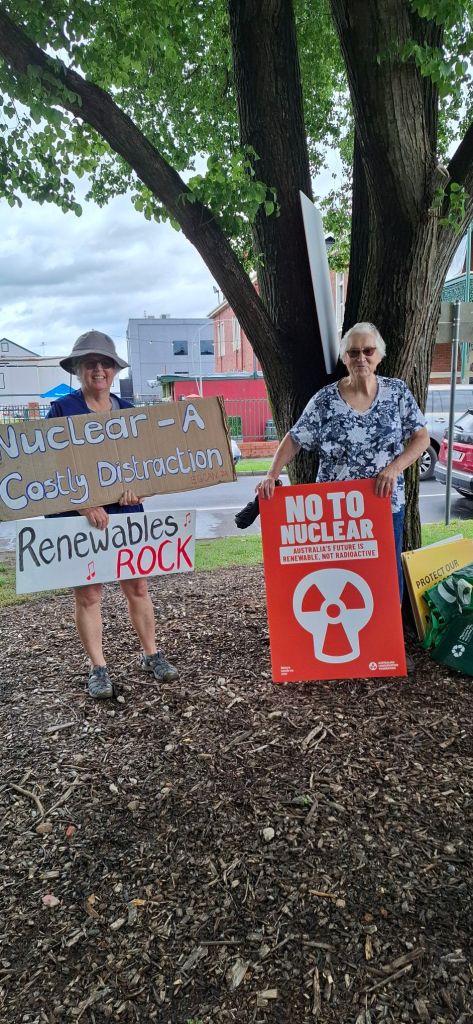


Protesters gather for a group photo and to chant slogans against adopting nuclear power.
 Climate News