

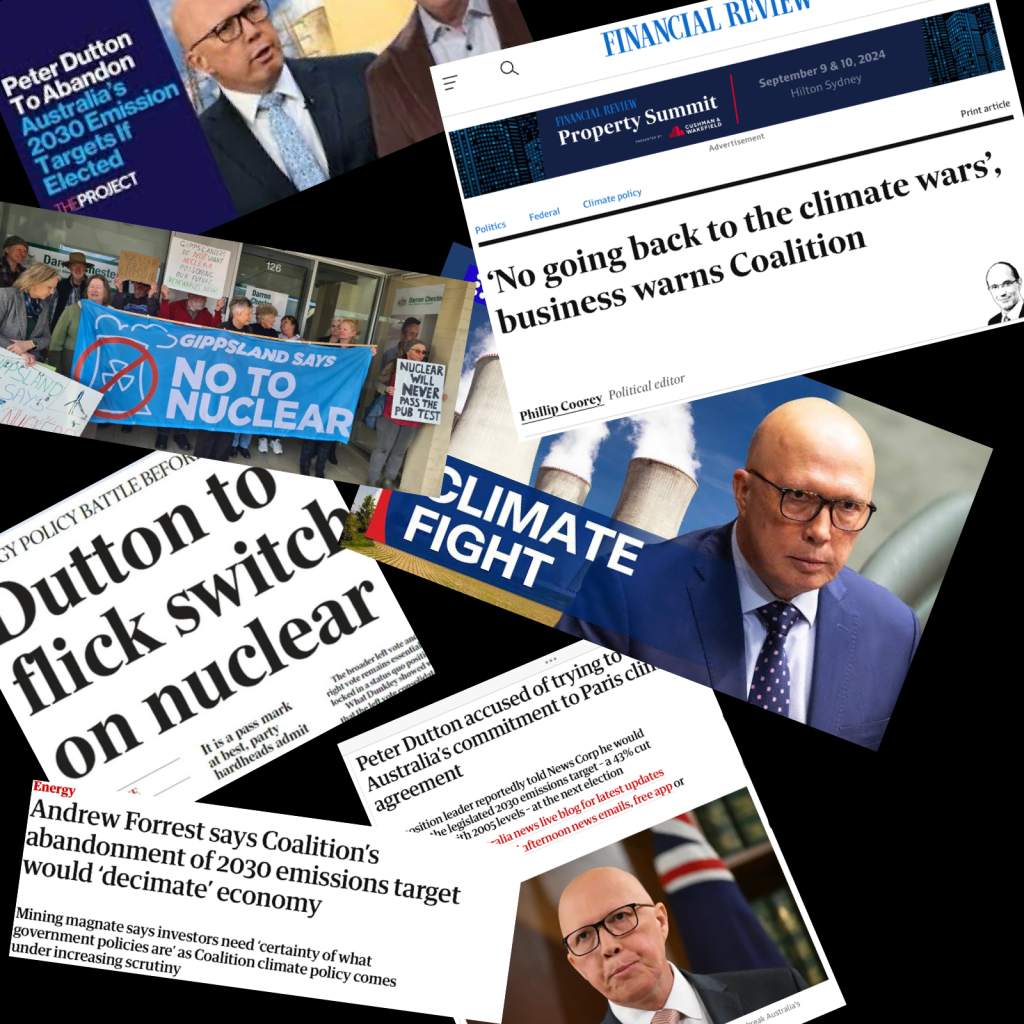
To go nuclear or not, it’s on everyone’s lips and certainly everyone has an opinion. Most people are either for or against, unlike our local Gippsland federal member who appears to continue to take a position right in the middle which he describes as “keeping an open mind”. Perhaps that is wise, that way you don’t immediately lose half the voting population!
He is taking the approach that he will listen to the locals but the Liberal National Party (LNP) are taking the stand that the nuclear power stations would proceed despite opposition from either the locals or the state. If this is the case then it doesn’t really matter whether the locals want it or not, it will go ahead anyway. So it would seem that no matter how much listening to the locals that he might do, if the LNP are in power a nuclear Latrobe Valley will happen.
There is always the argument of the possibility of jobs, very important, and yes the Latrobe Valley does have existing infrastructure and a skilled workforce. But how many of these workers are experienced or skilled in building a nuclear power station? Such a project requires a high level of expertise to ensure its safety. Making the transition from coal to renewables for workers is much easier, quicker, and does not require relocating overseas in order to gain the required experience.
Interestingly the national branch of the Electrical Trades Union (ETU) have declared that they are against nuclear power stations for their workforce. Their website states “Nuclear is not a solution to our energy needs. It is dangerous, costly, creates toxic waste and has the potential to take us down the path of dangerous weaponry”.
One of the big concerns of the ETU is that the LNP plan will kill renewable energy jobs. The website states that by 2030 there will be 1.8 million jobs in renewables, and by 2050 around 1.8 million people employed in this area. This is opposed to the 400 direct jobs required to run a nuclear power station.
Unfortunately even the announcement of a possible plan for nuclear power will impact investment in renewables due to the uncertain nature of the economy in this area, and delay projects already
in the pipeline, resulting in fewer immediate jobs being available for workers who need them now.
Further information can be found on the ETU nuclear specific site www.nofuture4nuclear.org
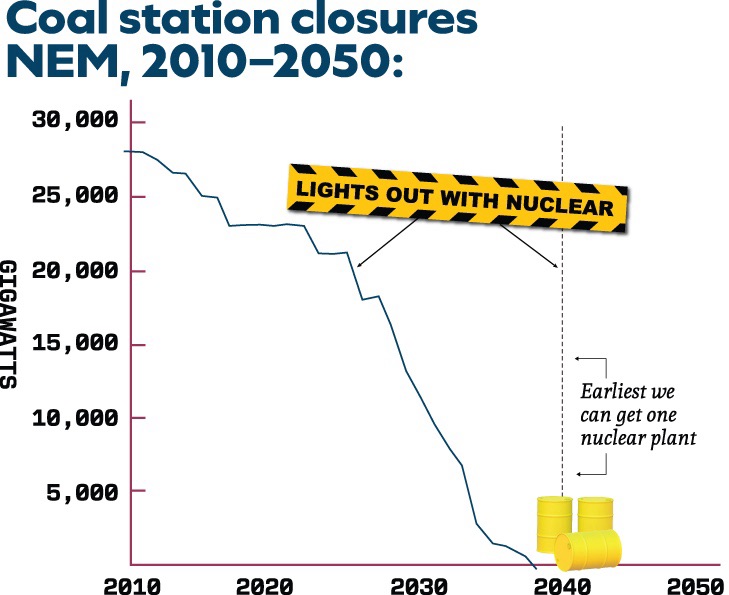
Our local member states that what Australian’s really need is a “facts campaign” but he offers no facts in relation to the LNP policy for nuclear power. The only information on his website is the same article that appeared in the Greater Eastern Mail on June 21st 2024 which contains no detail or facts.
I could be wrong about this (due to the shortage of facts that are to be found on the LNP website), but my understanding is that nuclear power stations are to be state owned, ie paid for by the taxpayer. Surely this would involve massive amounts of capital at the same time as more massive amounts of money are required to build the AUKUS submarines. It is hard to imagine how we as a nation can afford this as well as have any money left for mundane things like health, education, or roads.
The other particular scary concept is that governments seem to have shown themselves to be notoriously inept when dealing with large scale public infrastructure. Cost and time blowouts are common. A prime example of this was demonstrated when the LNP cancelled the submarine contract with France which is now thought to cost possibly up to $5.5b despite the contract being discontinued, and with nothing to show for all those taxpayer dollars.
Another example could be the blowouts that have occurred with the building of the Hinkley Point nuclear power station in the UK which was originally promised in 2007 to be completed by 2017 at a cost of around $17 billion. Now it is thought that it will probably be finished by 2031 and is estimated to cost $92 billion. Of course there are countries that can run projects to time and cost, think China, but Australia is not one of these. With no nuclear industry experience or expertise to speak of it is ripe for exorbitant time and cost increases.
So yes I agree with our local member that facts are good and ones based on proper science, even better, and I look forward to hearing his at some stage when they are revealed. Meanwhile I am still happy with my solar panels meeting most of my energy needs and exporting the the excess to the grid for use by industry and others.
Unfortunately this debate is likely to divide communities rather than unite them, perhaps that is the point. It will certainly distract from the issues of the moment some of which require our urgent attention. It will certainly delay the demise of fossil fuels and make a big contribution to Australia not meeting the emission reduction targets that have been set. Once again perhaps that is the point.
Opinion piece: Nola Kelly
 Climate News