

by John Hermans
The transition to a cleaner, safer world is underway as the world’s energy system transforms and we move towards battery electric vehicles (EV’s).
Large volumes of energy in the form of fossilised liquid have served humanity so well to get us into the 20th century and achieve such high living standards. But the vast quantities of fossil liquid fuels we use daily are causing pollution and climate instability, making it crucial that we reduce our reliance on mined petroleum resources and move away from internal combustion engines (ICE). While the transition raises concerns regarding sourcing additional metals and adopting new processes, I have full confidence in the ingenuity of science to overcome obstacles as technology develops.
Our world requires 2,500 million tonnes of iron ore per year producing steel to keep us on our development path and 5,800 million tonnes per year of fossil fuels, almost entirely burnt in highly inefficient internal combustion engine (ICE) road vehicles, boats and planes.
Cries of unsustainable mining, human rights abuses, additional key rare earth elements and copper shortfalls for the EV transition sound the alarm bells ringing. Some might even scoff and say it’s never going to happen.
Consider the extraction of lithium, an abundant mineral. In 2023, lithium extraction had been elevated to 0.4 million tonnes per year, still some 5000 times less than steel. The exponential growth of lithium mining will eventually plateau as other elements, such as sodium, are developed in ever-improving battery technology. Human rights abuses raised in relation to the mining of cobalt are also being addressed, and current mass production runs of electric vehicles coming out of China have been fitted with cobalt-free, lithium-iron-phosphate batteries. These are now used in over 75% of all Electric Vehicles (EVs) coming from this region.
Additionally, engineers and designers are constantly pushing for more sustainable options. The rare earth elements of neodymium and dysprosium, largely resourced from continental China, are no longer required in the manufacturing process of making permanent magnet motors, whilst still maintaining high functionality. Tesla’s initiatives to minimise copper use through voltage and wiring tweaks and innovative aluminium use are reducing copper use and saving on costs.
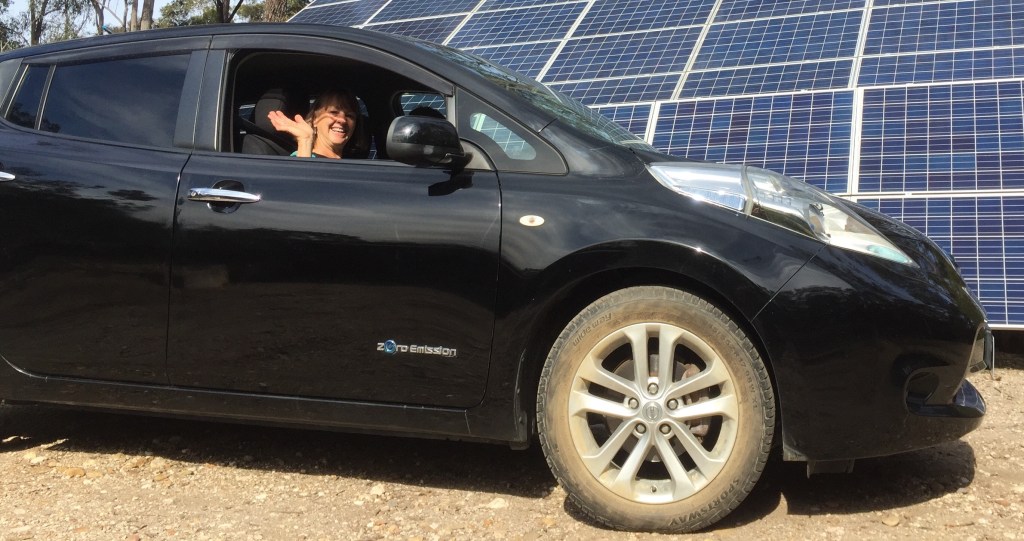
Clean solar power has so much potential to energise this change. Our family, living off-grid, runs an electric car. Full-battery electric cars, combined with significant power from solar photovoltaic home rooftop energy collectors are within reach of many of us. In fact, I can count more than twenty such cases.
The value of solar as a vehicle fuel is astounding. The annual energy output of a single hectare of land at this latitude with a 90% covering of solar panels is around 2,600 MW hours per year. This is enough to drive a modern electric vehicle a distance of 15 million km, at 165Whrs/km. Simple maths reveals that 1.5 million litres of fossil fuel would be burnt to travel the equivalent distance in an internal combustion engine (ICE) at 10L/100km.
The negative implications of internal combustion engine (ICE) usage globally are staggering, including poor efficiency, carbon dioxide emissions and toxic tail-pipe poisons leading to millions of human deaths. But other issues include complex, dirty and costly maintenance, a dwindling supply of fossil fuels, increasing costs, water usage and pollution, energy reliance from other countries, crude and refined oil spillage, international wars over security, and military usage of petroleum in order to maintain supply.
The transformation to battery electric vehicles and a cleaner, safer world is underway, and the advantages far outweigh any obstacles that may arise. Fans of internal combustion engines (ICE) are in for a painful but swift withdrawal.
 Climate News